If you live with rheumatoid arthritis, lupus, or psoriatic arthritis, you’ve probably heard: “see your rheumatologist and maybe look into functional medicine too.”That advice isn’t random. Autoimmune diseases actually affect more than 15 million Americans, and over a third of those live with more than one condition at once. This is a sign of how deeply connected your immune system, gut, and hormones really are. That’s why a combined approach matters: a rheumatologist treats the diagnosis in front of them; an online functional medicine autoimmune doctor asks what’s causing it underneath. Neither viewpoint is complete alone, which is exactly why this guide treats them as teammates, not competitors, working from the same file toward the same recovery.
Overview: How Functional Medicine and Rheumatology Work
Functional medicine and rheumatology work together by dividing responsibility: rheumatologists manage diagnosis, medication, and disease monitoring, while functional medicine addresses gut health, nutrition, and lifestyle triggers fueling inflammation. Used together, with both providers informed of each other’s plans, they offer more complete autoimmune care than either approach delivers alone.
What Your Rheumatologist Focuses On — And What They Don’t Have Time to Address
Areas They Focus On
Diagnosis and Antibody Testing
Your rheumatologist uses bloodwork like RF and anti-CCP antibodies, along with imaging such as X-rays or ultrasound, to confirm conditions like rheumatoid arthritis, lupus, or psoriatic arthritis early, before joint damage becomes irreversible or harder to control.
Medication Management
They also prescribe and monitor DMARDs, biologics, or immunosuppressants designed to slow disease progression and calm an overactive immune system. This includes adjusting dosages, watching for side effects, and switching treatments when a medication stops working effectively.
Organ and Complication Screening
Conditions like lupus can affect your kidneys, heart, and lungs, too, so your rheumatologist screens for organ involvement through bloodwork and referrals. Catching complications early is critical, since some autoimmune damage can be irreversible once it progresses.
What They Don’t Have Time to Address
- Gut health and digestion: Rheumatology visits rarely check whether leaky gut or bacterial imbalance is quietly feeding the inflammation driving your joint symptoms.
Nutrition and food triggers: There’s usually no time to look for which specific foods, like gluten or dairy, might be worsening your individual flares. - Stress and sleep quality: Chronic stress and poor sleep raise cortisol levels and disrupt immune regulation, but they rarely come up in a 15-minute visit with a rheumatologist.
- Environmental exposures: The toxins, mold, and heavy metals can quietly fuel inflammation, yet standard rheumatology visits don’t typically screen for these exposures.
- Root-cause lab testing: Other than the standard antibody panels, deeper markers for nutrient deficiencies or gut imbalance usually fall outside a rheumatologist’s field.
|
Ready to Fill the Gaps Your Rheumatologist Doesn’t Have Time For? Dr. David Bilstrom offers concierge functional medicine care that looks at your gut, nutrition, stress, and root causes, working alongside your existing rheumatology treatment, not replacing it. |
What Functional Medicine Adds to Your Rheumatology Care
Gut Microbiome Restoration Protocols
Using stool testing and targeted probiotics or prebiotics, functional medicine works to repair the gut lining and rebalance bacteria linked to autoimmune flares. Many patients receive this kind of care through functional nurse practitioner programs, where trained practitioners build and adjust these protocols alongside your care team. This restoration process supports your immune system from the inside, complementing the immune-modulating effect of your medication.
Personalized Anti-Inflammatory Nutrition Plans
A functional medicine doctor will make a proper eating plan around your labs and symptoms, often testing food sensitivities directly. It might include eliminating gluten, dairy, or sugar, increasing omega-3-rich foods, and adding anti-inflammatory spices like turmeric. So, instead of generic “eat healthy” advice, you get a plan designed to lower your inflammatory load alongside your prescribed medication.
Targeted Nutrient and Supplement Support
Autoimmune conditions and certain medications can deplete key nutrients such as vitamin D, B12, or magnesium. This is often one of the first things an online functional medicine autoimmune doctor checks, since correcting these gaps early through targeted supplementation like vitamin D3 or magnesium glycinate helps your body manage inflammation better and repair tissue more effectively.
Stress Physiology and Sleep Optimization
Functional medicine builds simple daily habits like breathwork, better sleep routines, and adrenal support to lower stress hormone levels and calm your nervous system. These habits are often central to healing autoimmune disease naturally, since stress hormones directly affect your immune system. Managing them well can mean fewer flare-ups over time.
Signs It’s Time to Add Functional Medicine to Your Rheumatology Care
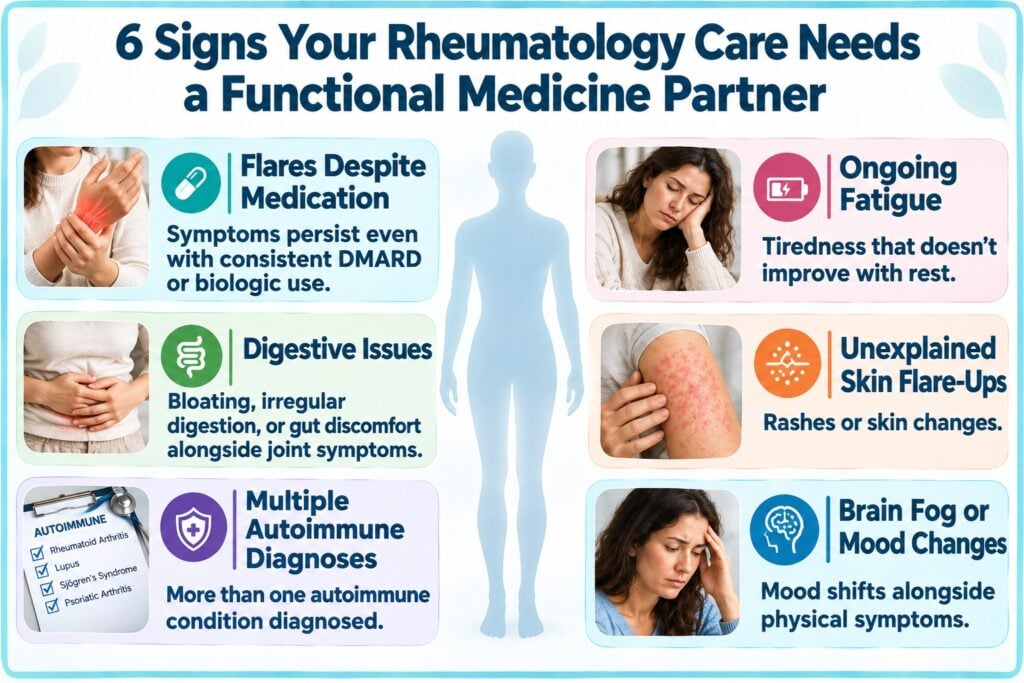
Not every symptom shows up clearly on a lab report or fits neatly into a 15-minute appointment. Sometimes your body is already telling you something well before your next visit. Take a look below and see how many feel familiar:
How to Bring Both Approaches Together Without Conflict
You need to start by telling both providers about each other. So, share lab results, supplements, and treatment plans openly. This kind of coordination is really what integrative autoimmune care looks like in practice: two providers, one shared plan. Also, ask your functional medicine practitioner to coordinate around your rheumatologist’s medication schedule, and never adjust prescribed medication without their approval.
Conclusion
Hence, your doubts regarding autoimmune and inflammatory conditions must be clear by now. When a rheumatologist’s clinical precision meets functional medicine’s root-cause focus, you get a fuller picture of your health. If you are sorted with the rheumatologist but need help with functional medicine? Don’t worry, Dr. David Bilstrom brings years of experience in functional medicine, helping patients get integrative, root-cause treatment plans that work smoothly alongside their specialists.
|
Your rheumatology care deserves the right functional medicine partner, not just a prescription. |
FAQs About Functional Medicine and Rheumatology
“Got a Revolution, got to Revolution.” Jefferson Airplane
Dr. David Bilstrom
Autoimmune Functional Medicine Doctor